
An 18-year-old medical student’s rehabilitation journey

Table of Contents
- Introduction
- Understanding the Challenges
- Clinical Assessment
- My Rehabify's Physiotherapy Approach
- The Rehabilitation Journey
- Progress During Rehabilitation
- Outcome After One Year
- Transition Towards Independent Rehabilitation
- A Message for Patients and Families
- Patient Images and Rehabilitation Progress
An 18-year-old student came to my OPD with significant thoracolumbar scoliosis, persistent back pain and pain radiating into the legs. The spinal curvature was visibly prominent and was affecting his overall movement and function.
For a young student, ongoing pain and restricted movement can affect more than physical comfort. It may also influence concentration, confidence, participation in daily activities and the ability to sit, stand or move comfortably for longer periods.
Assessment
Clinical assessment revealed considerable spinal asymmetry, back pain, radiating leg symptoms and associated muscle imbalance. His movement patterns and functional tolerance were also affected.
The rehabilitation plan was therefore focused not only on the appearance of the spinal curvature, but also on improving comfort, movement quality, strength, confidence and independence.
My Rehabify’s Physiotherapy Approach
A structured, individualized rehabilitation programme was followed, incorporating:
-
Schroth-based scoliosis exercises
-
Targeted strengthening and stretching
-
Spinal mobility and movement-based exercises
-
McKenzie-based exercises where appropriate
-
Postural awareness and movement education
- Gradual progression of exercises according to tolerance
The programme was progressively modified according to his symptoms, movement quality and functional response. Exercises were adjusted as his strength, mobility and confidence improved.
Progress
Following consistent rehabilitation:
- Back pain significantly improved
- Radiating leg pain reduced considerably
- Spinal movement and functional capacity improved
- Muscle balance and movement control improved
- Confidence with daily movement increased
- Visible postural and spinal asymmetry showed noticeable improvement
Progress was gradual and required consistency. The focus was not on quick changes, but on helping the patient move with greater comfort and control over time.
Outcome
After approximately one year of consistent rehabilitation, the patient demonstrated meaningful improvement in pain, function and visible spinal alignment.
He became more independent with his exercise programme, and the frequency of supervised sessions was gradually reduced as his condition improved. This allowed him to take greater responsibility for maintaining his progress through regular home exercises and improved movement habits.
Progress may not always be immediate or linear. Some days may feel easier than others, but regular guidance and gradual progression can make a meaningful difference over time.
Patient Says
Scoliosis affects everyone differently, and recovery can also vary from person to person. With the right guidance, exercises tailored to individual needs, and regular practice, many people can improve their movement, strength, comfort and confidence.
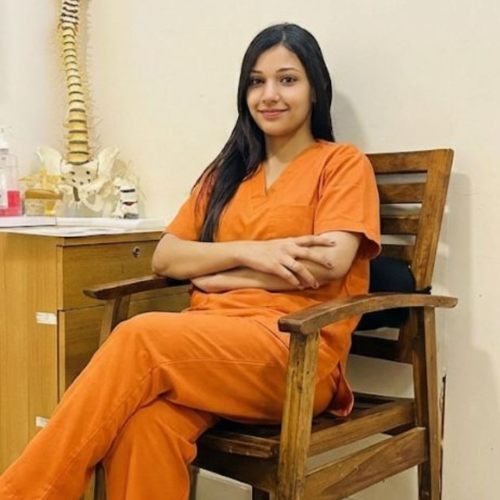
About the Author - Dr. Priya Gaur
Physiotherapist at My Rehabify
Dr. Priya Gaur (PT), MPT – Orthopaedics is the Founder and Chief Physiotherapist at My Rehabify Physiotherapy, Delhi. With 7+ years of clinical experience, she specializes in orthopedic, sports injury, neurological, and post-operative rehabilitation. This article is based on evidence-based physiotherapy practices and her extensive clinical expertise to provide accurate, reliable, and patient-focused health information.